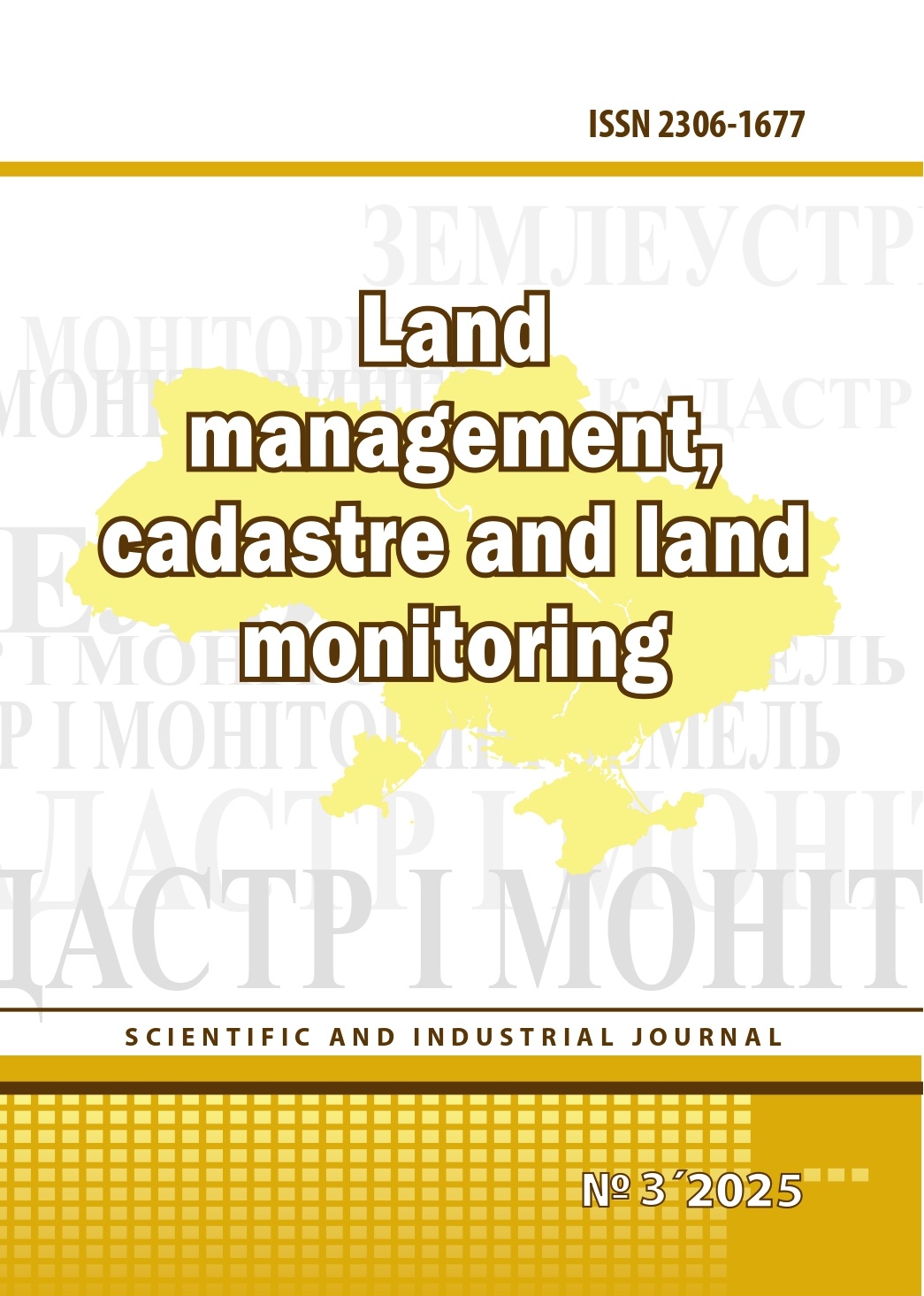
Towards a contemporary theory of land management
DOI:
https://doi.org/10.31548/zemleustriy2025.04.02Keywords:
land organisation theory, spatial land-use regimes, boundaries and borders, spatial value, axiomatic framework of land organisation, land administration methodology, digital cadastre, institutional design, spatial governanceAbstract
The article is devoted to the formation of the modern theory of land organisation as an independent fundamental scientific discipline through the systematic formulation of its subject and object, identification of leading theoretical models, articulation of the axiomatic basis, and organization of methodological tools capable of ensuring the transition from an ecosystem-technocratic understanding of space to its institutional-value comprehension. Building on a critical analysis of the international paradigm of land administration, Ukrainian doctrinal developments, institutional theory, property rights theory, and spatial economics, the object and subject matter of land organisation are clarified: the object is recognized as a multidimensional socio-spatial continuum in which territory is transformed into an ordered space of rights, restrictions, regimes, rents, and risks; the subject matter is the emergence, structure, and dynamics of spatial land-use regimes as a system of legal titles, servitudes (easements), zones, corridors, and reservations in multi-layer (surface–subsurface space–air column) and multi-temporal dimensions. An axiomatic core of the theory of contemporary land organisation is formulated. It is shown that land organisation methodology should include institutional analysis, theoretical-legal dogmatics of spatial regimes, spatial-economic modelling of rents, topological and network approaches, environmental accounting, geoinformation and algorithmic modelling, scenario analysis, and procedures of spatial justice. The core of the scientific problems of land organisation theory is generalized and systematized, the solution of which is a necessary precondition for the transition from fragmented normative-technical practice to institutionally mature spatial governance. The practical significance of the results lies in creating a conceptual framework for updating educational programmes, improving cadastral and planning systems, and developing standards for managing the value of space under conditions of digitalization and the growing role of spatial justice.
Keywords: land organisation theory; spatial land-use regimes; boundaries and borders; spatial value; axiomatic framework of land organisation; land administration methodology; digital cadastre; institutional design; spatial governance.
References
1. Dale, P., & McLaughlin, J. (2000). Land administration. Oxford: Oxford University Press. Available at: https://global.oup.com
2. Williamson, I. P., Enemark, S., Wallace, J., & Rajabifard, A. (2010). Land administration for sustainable development. Redlands, CA: ESRI Press Academic. Available at: https://esripress.esri.com
3. Bennett, R., Wallace, J., & Williamson, I. (2008). Organising land information for sustainable land administration. Land Use Policy, 25(1), 126–138. DOI: https://doi.org/10.1016/j.landusepol.2007.03.006
4. Enemark, S., Williamson, I., & Wallace, J. (2005). Building modern land administration systems in developed economies. Journal of Spatial Science, 50(2), 51–68. DOI: https://doi.org/10.1080/14498596.2005.9635042
5. Kaufmann, J., & Steudler, D. (1998). Cadastre 2014 – A vision for a future cadastral system. FIG. Available at: https://www.fig.net/resources/publications/figpub/cadastre2014.pdf
6. Steudler, D. (Ed.). (2014). Cadastre 2014 and beyond (FIG Publication No. 61). Copenhagen: FIG. Available at: https://www.fig.net/resources/publications/figpub/pub61/figpub61.pdf
7. International Organization for Standardization. (2012). ISO 19152:2012 Geographic information — Land Administration Domain Model (LADM). Geneva: ISO. Available at: https://www.iso.org/standard/51206.html
8. Oosterom, P. J. M., & Lemmen, C. (2015). The Land Administration Domain Model (LADM): Motivation, standardisation, application and further development. Land Use Policy, 49, 527–534. DOI: https://doi.org/10.1016/j.landusepol.2015.01.014
9. Enemark, S., Bell, K. C., Lemmen, C., & McLaren, R. (2014). Fit-for-purpose land administration (FIG Publication No. 60). Copenhagen: FIG; World Bank. Available at: https://www.fig.net/resources/publications/figpub/pub60/figpub60.asp
10. Enemark, S., McLaren, R., & Lemmen, C. (2021). Fit-for-purpose land administration—Providing secure land rights at scale. Land, 10(9), 972. DOI: https://doi.org/10.3390/land10090972
11. Food and Agriculture Organization of the United Nations. (2012). Voluntary guidelines on the responsible governance of tenure of land, fisheries and forests in the context of national food security. Rome: FAO. Available at: https://www.fao.org/tenure/voluntary-guidelines/en
12. United Nations Committee of Experts on Global Geospatial Information Management. (2020). Framework for effective land administration (FELA). New York: UN-GGIM. Available at: https://ggim.un.org/FELA
13. Ostrom, E. (1990). Governing the commons: The evolution of institutions for collective action. Cambridge: Cambridge University Press. Available at: https://www.cambridge.org/core/books/governing-the-commons/
14. Alexander, E. R. (2002). The public interest in planning: From legitimation to substantive plan evaluation. Planning Theory, 1(3), 226–249. DOI: https://doi.org/10.1177/147309520200100303
15. Pasakarnis, G., & Maliene, V. (2010). Towards sustainable rural development in Central and Eastern Europe: Applying land consolidation. Land Use Policy, 27(2), 545–549. DOI: https://doi.org/10.1016/j.landusepol.2009.07.008
16. Tretiak, A. M., Tretiak, V. M., Kuryltsiv, R. M., Priadka, T. M. & Tretiak, N. A. (2021). Upravlinnia zemel'nymy resursamy ta zemlekorystuvanniam: bazovi zasady teorii, instytutsiolizatsii, praktyky [Management of land resources and land use: basic principles of theory, institutionalization, practice], Bilotserkivdruk, Bila Tserkva, Ukraine, 227.
17. Tretiak, A.M., Tretiak, V.M., Priadka, T.M., Hunko L.A. & Tretiak, N.A. (2023). Zemlevporyadkuvannya v Ukrayini: rozvytok na zasadakh novitnʹoyi instytutsionalʹno-povedinkovoyi teoriyi [Land management in Ukraine: development based on the latest institutional and behavioral theory], Bilotserkivdruk, Bila Tserkva, Ukraine, 213.
18. Tretiak, A. M. (2016). Paradyhma rozvytku suchasnoi teorii zemleustroiu v Ukraini [Paradigm of the development of modern land management theory in Ukraine]. Land Management Bulletin, 9, 20–23.
19. Tretiak, A.M., Tretiak, V.M., Lobunko, V. M. & Lobunko, Yu.V. (2025). Otsinka vartosti pidtypiv zemlekorystuvannya silʹsʹkohospodarsʹkoho pryznachennya v proektakh konsolidatsiyi zemelʹ [Assessment of the value of subtypes of agricultural land use in land consolidation projects]. Аgroworld, 8, 30-37.
20. Shypulin, V. D. (2011). Systema zemel'noho administruvannia: osnovy suchasnoi teorii [Land administration system: basics of modern theory], KNUMH О.М. Beketova, Kharkiv, Ukraine, 220.
21. Dorosh, Y. M. (2012). Zemleustriy yak osnovopolozhnyy mekhanizm formuvannya zemelʹnykh vidnosyn v umovakh transformatsiynoyi ekonomiky [Land management as a fundamental mechanism for the formation of land relations in the context of a transformational economy]. Zemleustriy, kadastr i monitorynh zemelʹ [Land Management, Cadastre and Land Monitoring], 1-2, 6-14.
22. Perovych, L. M., Sai, V. M., & Malanchuk, M. S. (2015). Teoretychni zasady zemleustroiu: navchalnyi posibnyk [Theoretical foundations of land management: Textbook]. Lviv: Vydavnytstvo Lvivskoi politekhniky, 236.
23. Zevenbergen, J., Augustinus, C., Antonio, D., & Bennett, R. (2013). Pro-poor land administration: Principles for recording the land rights of the underrepresented. Land Use Policy, 31, 595–604. DOI: https://doi.org/10.1016/j.landusepol.2012.09.005
Downloads
Published
Issue
Section
License
Copyright (c) 2025 Землеустрій, кадастр імоніторинг земель

This work is licensed under a Creative Commons Attribution-ShareAlike 4.0 International License.
Relationship between right holders and users shall be governed by the terms of the license Creative Commons Attribution – non-commercial – Distribution On Same Conditions 4.0 international (CC BY-NC-SA 4.0):https://creativecommons.org/licenses/by-nc-sa/4.0/deed.uk
Authors who publish with this journal agree to the following terms:
- Authors retain copyright and grant the journal right of first publication with the work simultaneously licensed under a Creative Commons Attribution License that allows others to share the work with an acknowledgement of the work's authorship and initial publication in this journal.
- Authors are able to enter into separate, additional contractual arrangements for the non-exclusive distribution of the journal's published version of the work (e.g., post it to an institutional repository or publish it in a book), with an acknowledgement of its initial publication in this journal.
- Authors are permitted and encouraged to post their work online (e.g., in institutional repositories or on their website) prior to and during the submission process, as it can lead to productive exchanges, as well as earlier and greater citation of published work (See The Effect of Open Access).