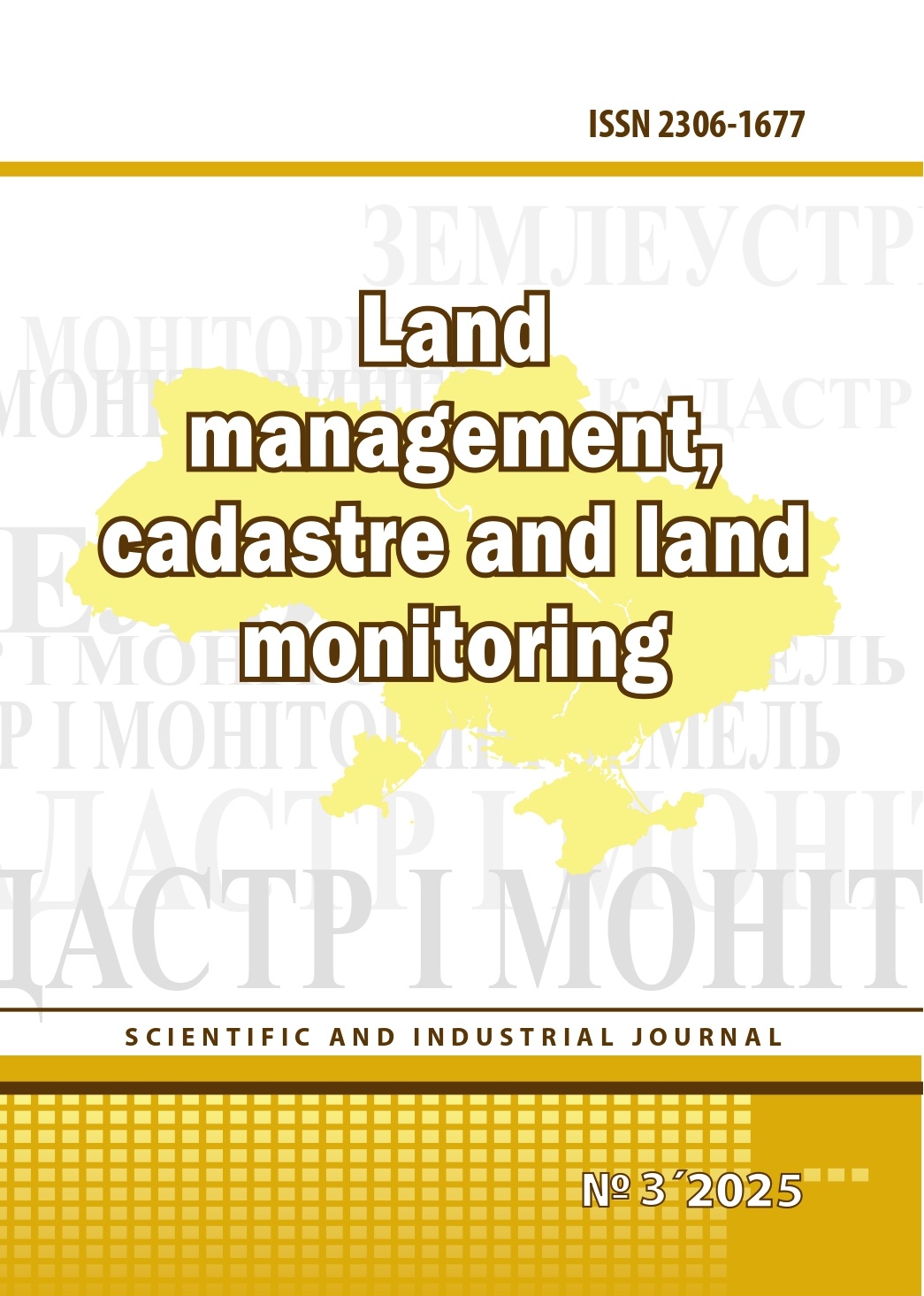
Geodetic support for monitoring changes in land deformation under anthropogenic loads and climate change
DOI:
https://doi.org/10.31548/zemleustriy2026.02.07Keywords:
geodetic support, monitoring, land use, land deformation, anthropogenic load, climate change, GIS, GNSS, UAVAbstract
The article addresses the issue of geodetic support for monitoring land surface deformations caused by anthropogenic pressure and climate change, which is an important prerequisite for preventing soil degradation and ensuring sustainable territorial development. The aim of the study is a comprehensive investigation of the geodetic support system as a fundamental basis for obtaining spatial data necessary for assessing and forecasting the dynamics of land resource conditions. Erosion-prone agricultural lands of the Mizoch territorial community in Rivne region were selected as the object for practical testing of the proposed solutions. The study analyzes the algorithm of geodetic monitoring, which includes preparatory and field work, data processing, GIS-based modeling of spatial changes, and the stage of managerial decision-making. Particular attention is paid to the fact that each stage requires the integration of specific instrumental methods and topographic-geodetic procedures to ensure high-precision recording of spatial shifts in terrain and soil cover over time. The principles of forming a monitoring framework are described in detail. In particular, the basic criteria for designing geodetic networks are formulated, including the layout of profile lines, reliable fixation of at least two reference benchmarks outside the zone of potential deformations, and the optimal placement of working stations directly within the risk area. The practical value of systematic ground-based geodetic measurements for the timely identification of erosion centers and soil displacements is demonstrated. The accumulated set of verified spatial data provides a reliable basis for the development of effective land reclamation measures and for making informed management decisions in the field of land protection within the community. Prospects for further research include the adaptation of deformation monitoring tools to other types of landscapes and specific land-use regimes.
Received: 30.04.2026;
Accepted: 12.05.2026;
References
1. Khainus, D. D., Mohylnyi, S. H., Vynohradenko, S. O., & Kapinos, N. O. (2025). Suchasni metody vyshchoi heodezii ta yikh zastosuvannia v monitorynhu deformatsii zemnoi poverkhni [Modern methods of higher geodesy and their application in monitoring land surface deformation]. Zbirnyk naukovykh prats Ukrainskoho derzhavnoho universytetu zaliznychnoho transportu, 213, 101–115. DOI: https://doi.org/10.18664/1994-7852.213.2025.341836
2. Dobrokhodova, O. V., Andrusiak, V. M., & Sushchenko, V. O. (2025). Deformatsiinyi monitorynh zemli ta pryrodnykh protsesiv [Deformation monitoring of land and natural processes]. Naukovyi visnyk budivnytstva, 112, 355–361. DOI: https://doi.org/10.33042/2311-7257.2025.112.1.44
3. Ng, A. H.-M., Ge, L., Chang, H.-C., & Du, Z. (2023). Geodetic monitoring for land deformation. Remote Sensing, 15, 283. DOI: https://doi.org/10.3390/rs15010283
4. Kolesnik, N. A., Kozhumiako, M. S. (2024). Heodezychnyi monitorynh deformatsii zemnoi poverkhni ta mahistralnoho hazoprovodu v zoni vplyvu hirnychykh robit [Geodetic monitoring of land surface deformation and main gas pipeline in mining impact zones]. Zemleustrii, kadastr i monitorynh zemel, 3, 123–133. DOI: https://doi.org/10.31548/zemleustriy2024.03.010
5. Naminat, O. S. (2020). Udoskonalennia metodiv heodezychnoho zabezpechennia monitorynhu liniinykh obiektiv v zonakh vplyvu pidzemnykh hirnychykh robit [Improvement of geodetic support methods for monitoring linear objects in underground mining impact zones] (PhD dissertation). Lviv.
6. Bulysheva, D., Leonidova, I., Malashchuk, O., Varfolomeieva, O., & Panasiuk, O. (2022). Zabezpechennia heodezychnoho monitorynhu zsuviv dlia zapobihannia ryzykam nadzvychainykh sytuatsii [Ensuring geodetic monitoring of landslides to prevent emergency risks]. Arkhitektura ta budivnytstvo, 23, 138–147. DOI: https://doi.org/10.31734/architecture2022.23.138
7. Shevchenko, R. Yu. (2020). Instrumentarii monitorynhu dovkillia mista Kyieva [Environmental monitoring tools of Kyiv city]. Kyiv.
8. Braslavska, O. V. (2025). HIS-tekhnolohii ta dystantsiine zonduvannia u monitorynhu zmin zemlekorystuvannia [GIS and remote sensing in land use change monitoring]. Mistobuduvannia ta terytorialne planuvannia, 89, 472–487. DOI: https://doi.org/10.32347/2076-815x.2025.89.472-487
9. Aimaiti, Y., Yamazaki, F., Liu, W., & Kasimu, A. (2017). Monitoring of land-surface deformation in the Karamay oilfield, Xinjiang, China, using SAR interferometry. Applied Sciences, 7, 772. DOI: https://doi.org/10.3390/app7080772
10. Domashchenko, H. T., Molnar, S. S., & Prokopenko, N. I. (2025). Heodezychne zabezpechennia protsesiv monitorynhu zmin u strukturi zemlekorystuvannia Ukrainy v period zbroinoi ahresii rosii ta postkonfliktnoho vidnovlennia [Geodetic support for monitoring land use changes during armed aggression and post-conflict recovery]. Zemleustrii, kadastr i monitorynh zemel, 2, 20–32. DOI: https://doi.org/10.31548/zemleustriy2025.02.02
11. Serbov, M. H., Danilova, N. V., & Pylypiuk, V. V. (2025). Zastosuvannia interferometrii dystantsiinoho zonduvannia dlia monitorynhu deformatsii zemel u zonakh boiovykh dii: metodolohichni zasady ta prykladni aspekty [Application of remote sensing interferometry for monitoring land deformation in war zones]. Avtomobilni dorohy i dorozhnie budivnytstvo, 117(2), 266–278. DOI: https://doi.org/10.33744/0365-8171-2025-117.2-266-278
12. Panasiuk, A. V., Shlapak, V. O., Tarnavskyi, D. O., & Shapar, Ya. R. (2025). Intehratsiia GNSS-tekhnolohii u systemu heodezychnoho monitorynhu ta upravlinnia hirnychym transportom [Integration of GNSS technologies into geodetic monitoring systems]. Tekhnichna inzheneriia, 2(96), 305–312. DOI: https://doi.org/10.26642/ten-2025-2(96)-305-312
13. Ćwiąkała, P., Gruszczyński, W., Stoch, T., Puniach, E., Mrocheń, D., & Matwij, W. (2020). UAV applications for determination of land deformations caused by underground mining. Remote Sensing, 12, 1733. DOI: https://doi.org/10.3390/rs12111733
Downloads
Published
Issue
Section
License
Copyright (c) 2026 Землеустрій, кадастр і моніторинг земель

This work is licensed under a Creative Commons Attribution-ShareAlike 4.0 International License.
Relationship between right holders and users shall be governed by the terms of the license Creative Commons Attribution – non-commercial – Distribution On Same Conditions 4.0 international (CC BY-NC-SA 4.0):https://creativecommons.org/licenses/by-nc-sa/4.0/deed.uk
Authors who publish with this journal agree to the following terms:
- Authors retain copyright and grant the journal right of first publication with the work simultaneously licensed under a Creative Commons Attribution License that allows others to share the work with an acknowledgement of the work's authorship and initial publication in this journal.
- Authors are able to enter into separate, additional contractual arrangements for the non-exclusive distribution of the journal's published version of the work (e.g., post it to an institutional repository or publish it in a book), with an acknowledgement of its initial publication in this journal.
- Authors are permitted and encouraged to post their work online (e.g., in institutional repositories or on their website) prior to and during the submission process, as it can lead to productive exchanges, as well as earlier and greater citation of published work (See The Effect of Open Access).