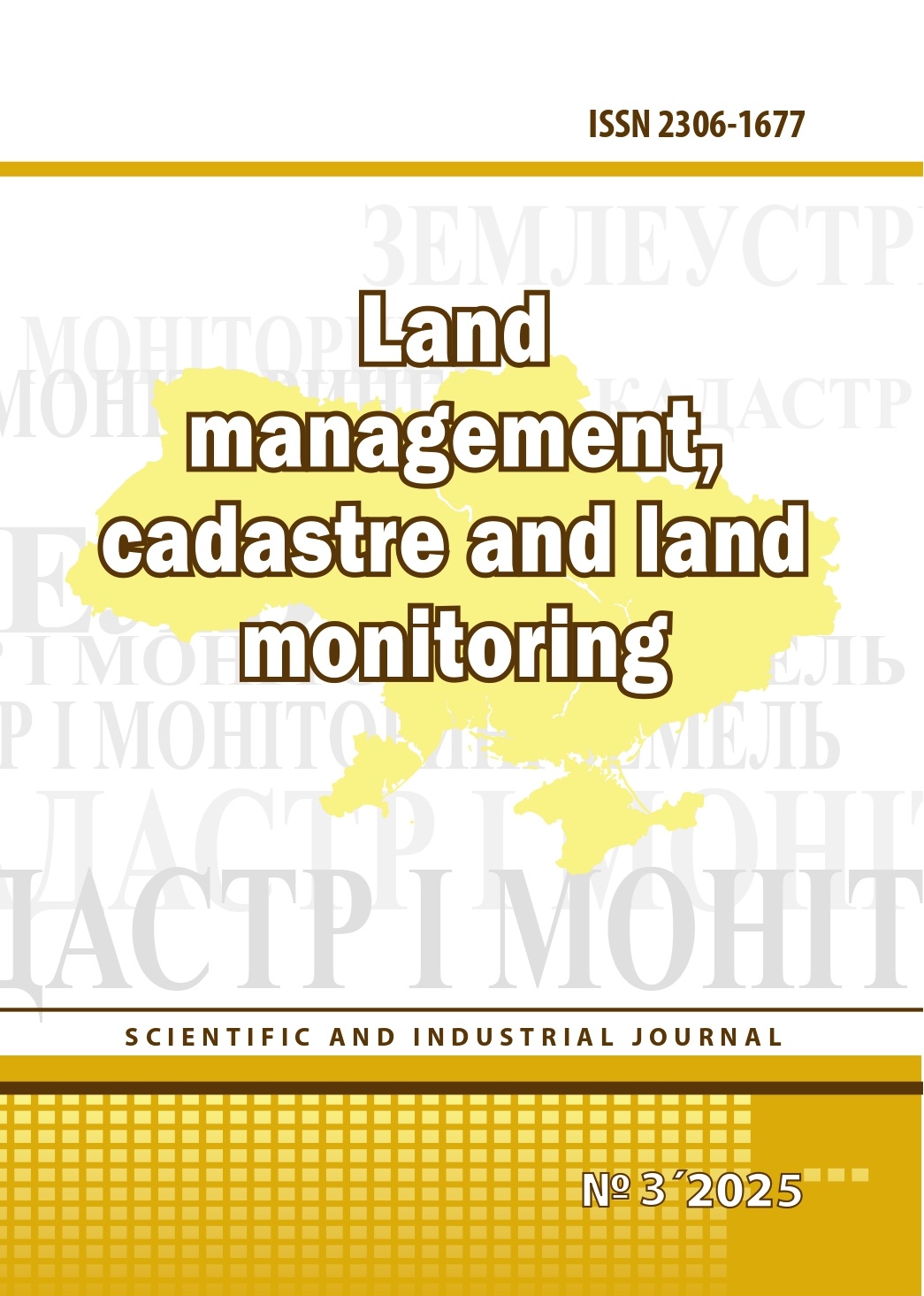
Geoinformation support for energy resource planning and accounting in communities as a tool for improving energy efficiency and ensuring sustainable development
DOI:
https://doi.org/10.31548/zemleustriy2026.03.013Keywords:
geographic information systems, energy resources, territorial community, energy efficiency, spatial planning, sustainable developmentAbstract
The article defines the methodological principles of geoinformation support for planning and accounting of energy resources at the level of territorial communities. It proposes the integration of spatial datasets, digital registers of municipal infrastructure, operational monitoring systems and analytical management tools. The capabilities of geoinformation platforms during the inventory of facilities, recording energy resource losses and preparing investment projects are analysed separately. The aim of the work is to develop an applied model of the use of geoinformation technologies in the planning, monitoring and accounting of energy resources at the community level. Attention is paid to combining information on consumption volumes, the state of engineering networks, local generation reserves and the probability of emergency situations. The study is based on current regulations, official statistics, open geospatial materials, technical characteristics of networks and registers of municipal facilities. The methodological part includes system analysis, spatial modelling, economic prioritisation of measures, scenario calculations and comparative assessment of management options in the field of energy consumption. The authors argue for the need to establish a unified digital database of energy resources of a territorial community. The article presents tools for visualising areas with excessive consumption, calculating technical losses in networks and determining sites for placing solar, wind and bioenergy installations. A method for selecting investment projects is proposed, considering the payback period, technical accessibility and environmental impact. The effectiveness of combining a geographic information system with remote reading meters and a local geoportal is proven. The development of digital twins of municipal infrastructure is considered a promising direction for further research. It is also advisable to explore the possibilities of artificial intelligence in predicting energy loads. An important task remains the creation of industry standards for the exchange of spatial data.
Received: 06.05.2026;
Accepted: 16.06.2026;
References
1. Azhaman, I. A., Khabib, A., Pushchina, N. V., & Melnychuk, O. I. (2023). Svitovyi dosvid rozvytku systemy enerhetychnoho menedzhmentu ta perspektyvy yoho vprovadzhennia v Ukraini [World experience in the development of energy management systems and prospects for its implementation in Ukraine]. Zhurnal stratehichnykh ekonomichnykh doslidzhen, 1(12), 73–81. DOI: https://doi.org/10.30857/2786-5398.2023.1.8
2. Achkasov, A., Popovych, N. V., Peresadko, V. A., & Gordeziani, T. (2024). Heoinformatsiine zabezpechennia heoportaliv terytorialnykh hromad: dovoienni realii y pisliavoienni perspektyvy [Geoinformation support of territorial community geoportals: Pre-war realities and post-war prospects]. Visnyk Kharkivskoho natsionalnoho universytetu imeni V. N. Karazina. Seriia “Heolohiia. Heohrafiia. Ekolohiia”, 60, 124–135. DOI: http://dx.doi.org/10.26565/2410-7360-2024-60-09
3. Hromadska spilka “Bioenerhetychna asotsiatsiia Ukrainy.” (n.d.). Available at: https://uabio.org/
4. Zghurovskyi, M. Z., Boldak, A. O., Boiarynova, K. O., Dunska, A. R., et al. (2021). Forsait: vyklyky enerhetychnii nezalezhnosti krain i rehioniv svitu na serednostrokovomu (do 2025 roku) i dovhostrokovomu (do 2030 roku) chasovykh horyzontakh Foresight-Energy-ua-2021 [Foresight: Challenges to energy independence of countries and regions of the world in the medium-term (to 2025) and long-term (to 2030) horizons]. Kyiv: National Technical University of Ukraine “Igor Sikorsky Kyiv Polytechnic Institute”, 188. Available at: http://wdc.org.ua/uk/%20energy_foresight2021
5. Cabinet of Ministers of Ukraine. (2024). Natsionalnyi plan z enerhetyky ta klimatu na period do 2030 roku [National energy and climate plan until 2030]. Kyiv. Available at: PDF document.
6. Kucher, A. V., & Synytsia, O. (2025). Ekonomika y stale upravlinnia enerhetychnymy resursamy v ahrarnii sferi [Economics and sustainable management of energy resources in the agricultural sector]. Plovdiv: Academic Publishing House Talent, 376.
7. Sukhodolia, O. M. (2023). Enerhetychna bezpeka Ukrainy: perspektyvna model upravlinnia ryzykamy [Energy security of Ukraine: A prospective risk management model]. Kyiv: National Institute for Strategic Studies, 136. DOI: https://doi.org/10.53679/NISS-book.2023.01
8. Buonomano, A., Giuzio, G. F., Maka, R., Russo, G., & Zizzania, S. (2026). GIS-driven planning of energy communities: Optimising renewables, storage, and demand aggregation in urban areas. Renewable Energy, 256, 124521. DOI: https://doi.org/10.1016/j.renene.2025.124521
9. Chowdhury, A. K. (2025). Smart renewable energy integration for precision agriculture in off-grid areas. Applied Agriculture Sciences, 3(1), 1–6. DOI: https://doi.org/10.25163/agriculture.3110286
10. Dedinec, A., Dedinec, A., Nakev, S., Dimitriev, D., Mihajloska, E., Kocarev, L., Zec, M., Oakleaf, J. R., & Kiesecker, J. M. (2025). Smart energy siting to guide renewable energy transition. Research Square. Preprint. DOI: https://doi.org/10.21203/rs.3.rs-7474783/v1
11. Karpash, M., Zhovtulia, L., Soroka, N.-A., & Maksymiuk, S. (2025). Development of municipal energy security plans for small-sized municipalities in Ukraine: Challenges, forecast and policy recommendations. E3S Web of Conferences, 654, 05003. DOI: https://doi.org/10.1051/e3sconf/202565405003
12. Kochanek, A., Generowicz, A., & Zacłona, T. (2025). The role of geographic information systems in environmental management and the development of renewable energy sources–A review approach. Energies, 18(17), 4740. DOI: https://doi.org/10.3390/en18174740
13. Koçyiğit, A., Aksu, K., Terzi, A. F., & Demirel, H. (2026). Investigating the role of geographic information systems in advancing positive energy districts. The International Archives of the Photogrammetry, Remote Sensing and Spatial Information Sciences, XLVIII-4/W18-2025, 221–226. DOI: https://doi.org/10.5194/isprs-archives-XLVIII-4-W18-2025-221-2026
14. Makedon, V., Karpenko, L., Petko, S., Bondarenko, S., & Ryzhova, V. (2024). Economic efficiency and environmental benefits of the development of renewable energy sources. International Journal of Energy, Environment, and Economics, 32(2), 239–257. Available at: https://novapublishers.com/shop/economic-efficiency-and-environmental-benefits-of-the-development-of-renewable-energy-sources/
15. Makedon, V., Politykin, M., Hromyak, S., Novosad, I., & Doronina, I. (2025). The role of renewable energy in advancing SDG 7: Ensuring clean and affordable energy. Grassroots Journal of Natural Resources, 8(2), 485–505. DOI: https://doi.org/10.33002/nr2581.6853.080223
16. Nassif, W. G., Al-Timimi, Y. K., & Elhmaidi, D. (2025). GIS-AHP for optimal solar site selection: A case study of Iraq and its implications for climate change. International Journal of Sustainable Energy Planning and Management, 47, 71–89. DOI: https://doi.org/10.54337/ijsepm.10646
17. Zaichenko, S., Borychenko, O., & Trachuk, A. (2025). Geoinformation analysis of the prospects for the development of renewable energy sources in Ukraine, taking into account the remoteness of electricity consumers. Vidnovliuvana Enerhetyka, 2(81), 58–66. DOI: https://doi.org/10.36296/1819-8058.2025.2(81).58-66
Downloads
Published
Issue
Section
License
Copyright (c) 2026 Землеустрій, кадастр і моніторинг земель

This work is licensed under a Creative Commons Attribution-ShareAlike 4.0 International License.
Relationship between right holders and users shall be governed by the terms of the license Creative Commons Attribution – non-commercial – Distribution On Same Conditions 4.0 international (CC BY-NC-SA 4.0):https://creativecommons.org/licenses/by-nc-sa/4.0/deed.uk
Authors who publish with this journal agree to the following terms:
- Authors retain copyright and grant the journal right of first publication with the work simultaneously licensed under a Creative Commons Attribution License that allows others to share the work with an acknowledgement of the work's authorship and initial publication in this journal.
- Authors are able to enter into separate, additional contractual arrangements for the non-exclusive distribution of the journal's published version of the work (e.g., post it to an institutional repository or publish it in a book), with an acknowledgement of its initial publication in this journal.
- Authors are permitted and encouraged to post their work online (e.g., in institutional repositories or on their website) prior to and during the submission process, as it can lead to productive exchanges, as well as earlier and greater citation of published work (See The Effect of Open Access).