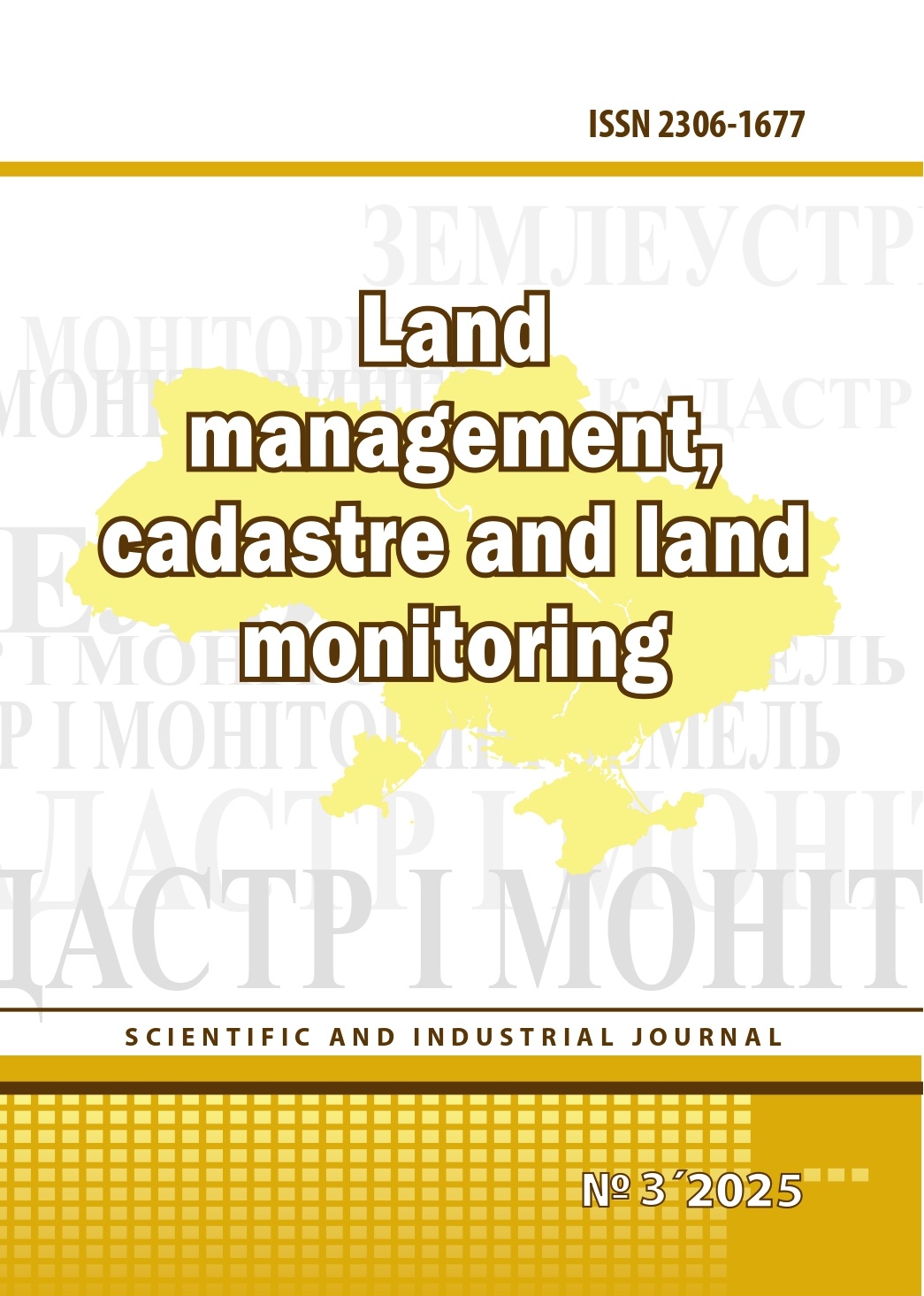
Analysis of cartographic models of ecological stability and anthropogenic load of the Zhydachiv urban territorial community
DOI:
https://doi.org/10.31548/zemleustriy2026.02.012Keywords:
land use, territorial community, ecological stability, anthropogenic load, cartographic modeling, GIS, integrated indicator, land use optimization, sustainable developmentAbstract
The article substantiates a methodological approach to the assessment and optimization of land use in territorial communities based on the integration of geoinformation analysis, environmental indicators, and cartographic modeling. The study was conducted using the example of the Zhydachiv urban territorial community, for which the current land-use structure was analyzed and the dominance of arable land (about 45%) was identified, leading to an increased level of anthropogenic pressure and reduced ecological stability of the territory.
A comprehensive assessment of the environmental condition was carried out using coefficients of ecological stability, anthropogenic load, and an integral indicator, which made it possible to quantitatively and spatially characterize the level of landscape transformation. Spatial differentiation of the ecological condition of the territory was revealed, and zones with different levels of environmental tension were identified, in particular central urbanized areas as hotspots of increased pressure and peripheral areas as zones of relative stabilization.
A series of cartographic models was developed to reflect the land-use structure, the level of anthropogenic impact, and the integral ecological condition, which allowed for identifying spatial patterns of territorial transformation. A land-use optimization scenario is proposed, aimed at increasing the area of natural land, reducing plowing intensity, and forming an ecological framework. The obtained results can be used to support decision-making in the field of rational land use and to ensure the sustainable development of territorial communities.
Received: 30.04.2026;
Accepted: 14.05.2026;
References
1. Dorohuntsov, S. I. (2003). Ekolohichni osnovy zemlekorystuvannia [Ecological foundations of land use]. Kyiv: KNEU, 256.
2. Tretiak, A. M. (2012). Zemleustrii v Ukraini: teoriia, metodolohiia [Land management in Ukraine: Theory and methodology]. Kyiv: Ahrarna nauka, 312.
3. Drebot, O. I. (2015). Stale zemlekorystuvannia: teoriia ta praktyka [Sustainable land use: Theory and practice]. Kyiv: NNTs IAE, 280.
4. Shyshchenko, P. H. (1999). Prykladna heoekolohiia [Applied geoecology]. Kyiv: Lybid, 320.
5. Kucher, O. V. (2010). Ekolohichna otsinka zemelnykh resursiv [Ecological assessment of land resources]. Lviv: Svit, 210.
6. Malczewski, J. (1999). GIS-based multicriteria decision analysis. New York: Wiley, 392.
7. Malczewski, J. (2006). Multicriteria decision analysis in geographic information science. International Journal of Geographical Information Science, 20(7), 703–726.
8. Burrough, P. A., & McDonnell, R. A. (1998). Principles of geographical information systems. Oxford: Oxford University Press, 333.
9. Goodchild, M. F. (1992). Geographical information science. International Journal of Geographical Information Systems, 6(1), 31–45.
10. Saaty, T. L. (2008). Decision making with the analytic hierarchy process. International Journal of Services Sciences, 1(1), 83–98.
11. Liu, Y., Wang, J., & Long, H. (2020). Analysis of land use transitions and their ecological effects. Land Use Policy, 95.
12. Zhang, X., Chen, Y., & Li, B. (2021). Remote sensing-based analysis of land use and ecological risk. Ecological Indicators, 122.
13. Rahman, M. M., Szabó, G., et al. (2021). GIS-based multi-criteria decision analysis for land suitability. Sustainability, 13(6).
14. Wang, J., Li, X., & Liu, Z. (2022). Spatial optimization of land use based on ecological constraints. Science of the Total Environment, 806.
15. Chen, W., Chi, G., & Li, J. (2023). Integrated assessment of land use sustainability. Ecological Indicators, 147.
16. Li, Y., Fang, F., & Song, J. (2024). Coupling human activity and ecological environment. Journal of Environmental Management, 340.
Downloads
Published
Issue
Section
License
Copyright (c) 2026 Land Management, Cadastre and Land Monitoring

This work is licensed under a Creative Commons Attribution-ShareAlike 4.0 International License.
Relationship between right holders and users shall be governed by the terms of the license Creative Commons Attribution – non-commercial – Distribution On Same Conditions 4.0 international (CC BY-NC-SA 4.0):https://creativecommons.org/licenses/by-nc-sa/4.0/deed.uk
Authors who publish with this journal agree to the following terms:
- Authors retain copyright and grant the journal right of first publication with the work simultaneously licensed under a Creative Commons Attribution License that allows others to share the work with an acknowledgement of the work's authorship and initial publication in this journal.
- Authors are able to enter into separate, additional contractual arrangements for the non-exclusive distribution of the journal's published version of the work (e.g., post it to an institutional repository or publish it in a book), with an acknowledgement of its initial publication in this journal.
- Authors are permitted and encouraged to post their work online (e.g., in institutional repositories or on their website) prior to and during the submission process, as it can lead to productive exchanges, as well as earlier and greater citation of published work (See The Effect of Open Access).