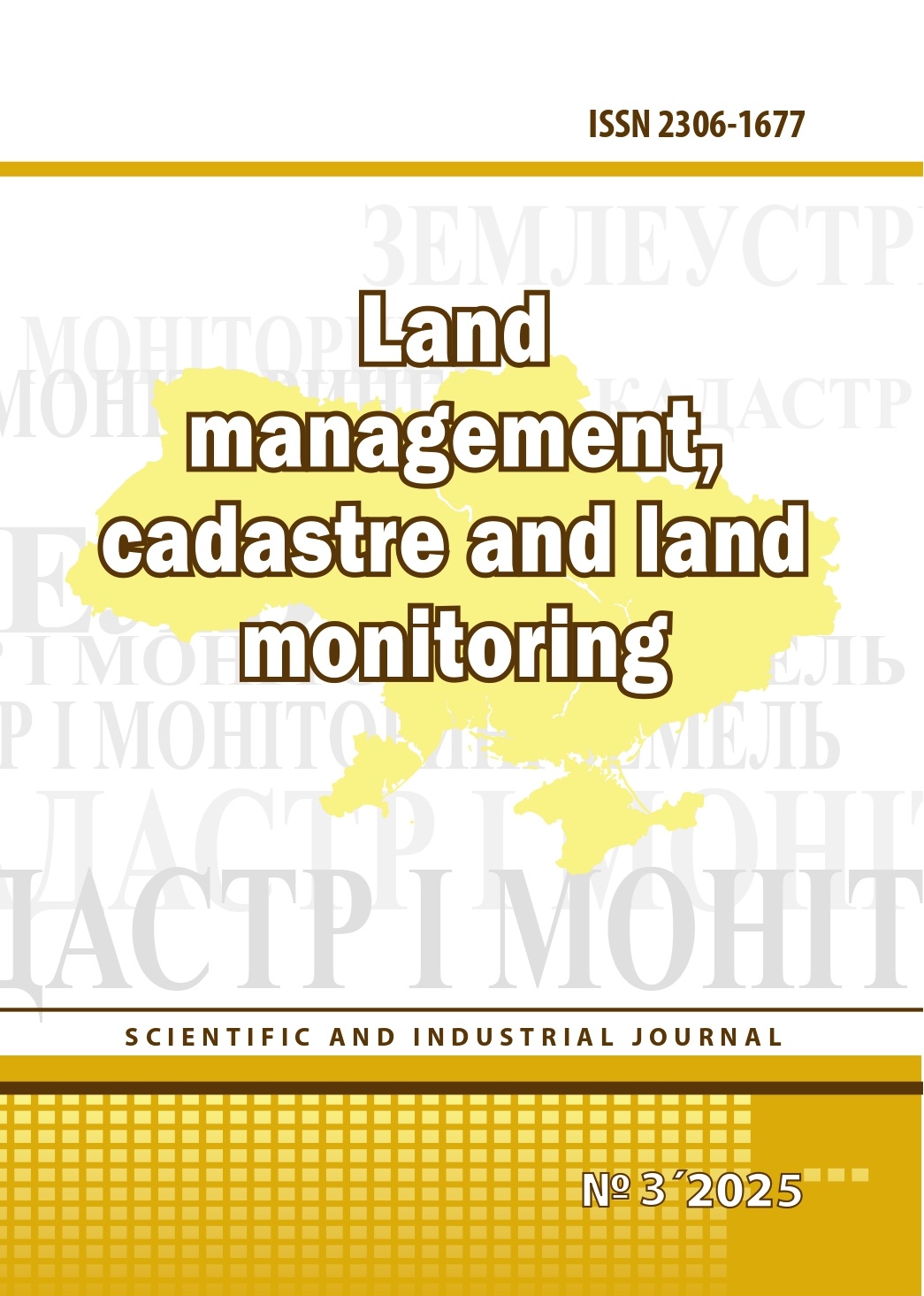
Axiology of Space as a Component of the Modern Theory of Land Use Organization: Value Regimes, Institutions, and Instruments of Spatial Order
DOI:
https://doi.org/10.31548/zemleustriy2026.01.01Keywords:
axiology of space, land use organization, value regimes of space, institutional regimes of land use, value conflict, commensurability, multicriteria optimization, geographic information system modeling, spatial planning, legitimacy, threshold constraints, management of the value of spaceAbstract
The novelty of this study lies in the comprehensive comparison of the two systems in terms of legal effectiveness, digitalization, and protection of property rights. The conclusions of the research can be used to improve the Ukrainian real estate registration model, integrate cadastral and registration processes, and enhance legal certainty, bringing it closer to European standards.
The article reveals the axiology of space as a component of the modern theory of land management and as a methodological response to the widespread reduction of space to geometric extension or a resource. It is substantiated that land management decisions always have not only a metric and resource-related dimension, but also a value-normative dimension, since space is a bearer of economic, environmental, social, cultural, security-related, and legal meanings and an arena of their conflicts. The purpose of the study is to conceptualize the theoretical and methodological foundations of the axiology of space in land management, to describe the mechanism of transition from values to institutional and design decisions, and to build a conceptual model of “value regimes of space.” The methodological basis consists of a systematized review of relevant scientific and framework sources, a conceptual analysis of basic categories (value, regime, legitimacy, admissibility), and a typologization of regimes supplemented by operationalization through indicator-metrics suitable for land management analytics. A definition of a value regime is proposed as a stable configuration of priorities закрепленої in institutions and practices, and a typology of regimes is presented (utilitarian-economic; environmental-protective; socially just; cultural-identification; security-related/risk-oriented; legal/procedural) with applied manifestations in land management and a set of quantitative metrics. The problem of commensurability is considered separately: it is shown that the use of a single metric for optimization models is possible only with a transparent distinction between threshold constraints (inadmissibility) and compromise criteria (weighted optimization), which opens the possibility of correct use of mathematical methods and geographic information system modeling in the design of spatial decisions. The practical value of the article lies in forming a categorically and instrumentally coherent framework for substantiating land management decisions as management of the value of space and for increasing the transparency of reconciling “benefit / irreplaceability,” “private interest / common good,” “local / general.”
Received: 19.02.2026;
Accepted: 03.03.2026;
References
1. Lefebvre, H. (1991). The production of space (D. Nicholson-Smith, Trans.). Basil Blackwell. Available at: https://iberian-connections.yale.edu/wp-content/uploads/2020/04/The-production-of-space-by-Henri-Lefebvre-translated-by-Donald-Nicholson-Smith.pdf
2. Herrera, A., & da Passano, M. G. (2006). Land tenure alternative conflict management. FAO. Available at: https://www.fao.org/4/a0557e/a0557e00.pdf
3. De Zeeuw, K., Blake, C., & Chaka, M. (2016, May). The agenda for a Group of Experts on Land Administration and Management within the United Nations [Conference paper]. FIG, Christchurch, New Zealand. Available at: https://www.researchgate.net/publication/306018423_The_agenda_for_a_Group_of_Experts_on_Land_Administration_and_Management_within_the_United_Nations
4. Sevatdal, H. (2002, April 19–26). Land administration and land management: An institutional approach [Abstract]. FIG XXII International Congress, Washington, DC, United States. Available at: https://www.fig.net/resources/proceedings/2002/fig_2002/fig_2002_abs/Ts7-5/TS7_5_sevatdal_abs.pdf
5. United Nations Committee of Experts on Global Geospatial Information Management. (2015). The application of geospatial information – Land administration and management (Version 3.1). Available at: https://ggim.un.org/meetings/GGIM-committee/documents/GGIM5/land%20admin%20and%20mngnt%20background%20paper%203.2%20final.pdf
6. Hull, S. A. (2024). All for one and one for all? Exploring the nexus of land administration, land management and land governance. Land Use Policy, 144, Article 107248. https://doi.org/10.1016/j.landusepol.2024.107248
7. Lemmen, C., van Oosterom, P., Kara, A., & Kalogianni, E. (2025). The Land Administration Domain Model: An overview (FIG Publication No. 84). International Federation of Surveyors (FIG) & ISO. Available at: https://gdmc.nl/3dcadastres/Figpub84.pdf
8. Oosterom, P., Kara, A., & Lemmen, C. (2025). LADM Edition II – Overview and progress report [Conference paper]. FIG LADM & 3D Cadastres Workshop. Available at: https://www.fig.net/resources/proceedings/fig_proceedings/fig2025/papers/ts06/TS06_vanOosterom_Kara_Lemmen_13279.pdf
9. UN-Habitat & GLTN. (2023). Teaching essentials for responsible land administration: Summary and guidance for education, research, and capacity development. UN-Habitat. Available at: https://unhabitat.org/sites/default/files/2023/06/teaching_essentials_for_responsible_land_administration_summary_and_guidance_for_education_research_and_capacity_development.pdf
10. Mitchell, D., Enemark, S., McLaren, R., van der Molen, P., & Lemmen, C. (2020). Teaching essentials of responsible land administration [Conference paper]. FIG Working Week 2020. Available at: https://www.fig.net/resources/proceedings/fig_proceedings/fig2020/papers/ts08b/TS08B_mitchell_enemark_mclaren_vandermolen_lemmen_10290.pdf
11. Ndugwa, R. P., & Omusula, C. K. (2025). Institutional frameworks, policies, and land data: Insights from monitoring land governance and tenure security in the context of Sustainable Development Goals in Kenya, Rwanda, Uganda, and Zambia. Land, 14(5), Article 960. https://doi.org/10.3390/land14050960
12. Dadashpoor, H., & Sajadi, A. (2024). Principles of just urban land use planning. Land Use Policy, 141, Article 107132. https://doi.org/10.1016/j.landusepol.2024.107132
13. Gonçalves, J. E., et al. (2025). Spatial justice in participatory planning: An integrated framework and lessons from practice. Frontiers in Sustainable Cities, 7. https://doi.org/10.3389/frsc.2025.1656745
14. Brown, G., & Fagerholm, N. (2015). Empirical PPGIS/PGIS mapping of ecosystem services: A review and evaluation. Ecosystem Services, 13, 119–133. https://doi.org/10.1016/j.ecoser.2014.10.007
15. García-Díez, V., García-Llorente, M., & González, J. A. (2020). Participatory mapping of cultural ecosystem services in Madrid: Insights for landscape planning. Land, 9(8), Article 244. https://doi.org/10.3390/land9080244
16. ESPON. (2024). No net land take: A review of the state-of-play in Member States, policy & tools. Available at: https://www.espon.eu/sites/default/files/attachments/ESPON_policy_brief_nonetlandtake.pdf
17. UN-Habitat & GLTN. (2012). Handling land: Innovative tools for land governance and secure tenure. UN-Habitat. Available at: https://local2030.org/library/403/Handling-Land-Innovative-tools-for-land-governance-and-secure-tenure.pdf
18. Dobriak, D. S., Martyn, A. H., Yevsiukov, T. O., & Kuzin, N. V. (2017). Ekonomichni problemy suchasnoho zemleustroiu v Ukraini [Economic problems of modern land management in Ukraine]. Balanced Nature Management, 4, 80–85.
19. Novakovskyi, L., Tretiak, A., & Dorosh, Y. (2018). Stan i problemy zemleustroiu obiednanykh terytorialnykh hromad u konteksti pidvyshchennia yikh finansovoi stiikosti [State and problems of land management of united territorial communities in the context of increasing their financial sustainability]. Land Management Bulletin, 12, 14–19.
20. Tretiak, A. M., Tretiak, V. M., & Hunko, L. A. (2022). Instytutsionalnyi rozvytok zemleustroiu ta zemlevporiadkuvannia v Ukraini u period hlobalizatsii [Institutional development of land management and land planning in Ukraine in the period of globalization]. Economy and State, 2, 19–25.
21. Tretiak, A. M., Tretiak, V. M., & Tretiak, N. A. (2024). Kontseptsii i zakonomirnosti rozvytku zemleustroiu v Ukraini [Concepts and regularities of land management development in Ukraine]. AgroWorld, 14, 3–11.
Downloads
Published
Issue
Section
License
Copyright (c) 2026 Землеустрій, кадастр і моніторинг земель

This work is licensed under a Creative Commons Attribution-ShareAlike 4.0 International License.
Relationship between right holders and users shall be governed by the terms of the license Creative Commons Attribution – non-commercial – Distribution On Same Conditions 4.0 international (CC BY-NC-SA 4.0):https://creativecommons.org/licenses/by-nc-sa/4.0/deed.uk
Authors who publish with this journal agree to the following terms:
- Authors retain copyright and grant the journal right of first publication with the work simultaneously licensed under a Creative Commons Attribution License that allows others to share the work with an acknowledgement of the work's authorship and initial publication in this journal.
- Authors are able to enter into separate, additional contractual arrangements for the non-exclusive distribution of the journal's published version of the work (e.g., post it to an institutional repository or publish it in a book), with an acknowledgement of its initial publication in this journal.
- Authors are permitted and encouraged to post their work online (e.g., in institutional repositories or on their website) prior to and during the submission process, as it can lead to productive exchanges, as well as earlier and greater citation of published work (See The Effect of Open Access).