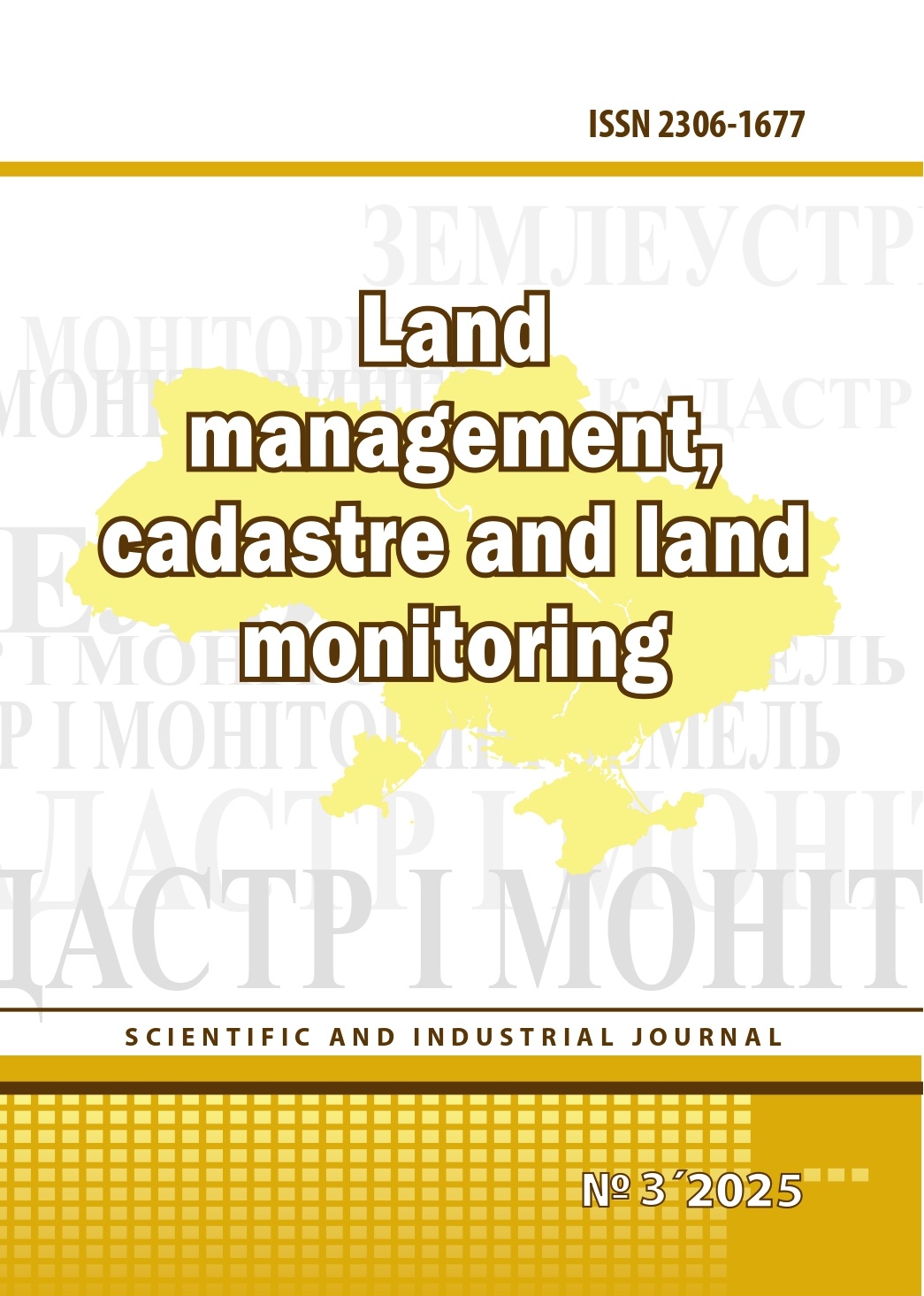
The intellectualisation of electronic surveying instruments in spatial management systems as a foundation for integrating artificial intelligence into the geoinformation environment
DOI:
https://doi.org/10.31548/zemleustriy2026.02.08Keywords:
artificial intelligence, geodetic instruments, spatial management, laser scanning, infrastructure monitoring, digital twinsAbstract
The article is devoted to the formation of applied foundations for the intellectualization of electronic geodetic instruments through their integration with artificial intelligence (AI) technologies. The study focuses on the transition from traditional measuring devices to adaptive geodetic systems. Such complexes maintain metrological stability in a changing environment. The methodology is based on a technical-analytical approach and structural modeling of intelligent devices. A comparative assessment of functional operating modes was carried out. An analysis of time series of geodetic observations was performed. Practices of artificial intelligence application in geoinformation systems were generalized. The information base consisted of the technical parameters of total stations and GNSS receivers. The characteristics of laser scanners and sensor monitoring platforms were used. Data from digital urban infrastructure management systems were applied.
The results confirm the effectiveness of computer vision algorithms. It was established that intelligent geodetic complexes form a new approach to the organization of spatial control of infrastructure and territories. The systems operate not only in the mode of coordinate fixation, but also in the format of continuous analysis of object conditions. Integrated machine learning algorithms assess displacement dynamics, signal stability, vibration load levels, and the nature of changes in spatial parameters in real time. Particular attention is paid to the integration of total station surveying, GNSS, LiDAR, photogrammetry, and unmanned platforms within a unified digital environment. The effectiveness of intelligent geodetic sensors in monitoring systems for bridges, dams, tunnels, transport hubs, and high-rise structures was separately confirmed. The practical value lies in the development of a concept for a new generation of geodetic complexes. New instruments combine precise measurements with predictive analytics. Software automatically supports management decision-making. The scientific novelty is determined by a comprehensive approach to the integration of artificial intelligence. Instrumental tools are combined with analytical models. Infrastructural aspects of technology implementation in geodetic practice are taken into account.
Received: 27.04.2026;
Accepted: 08.06.2026;
References
1. Dorozhko, Ye. V., & Udovenko, I. O. (2025). Intelektualni tekhnolohii v elektronnykh heodezychnykh systemakh publichnoho prostorovoho upravlinnia: evoliutsiia vid avtomatyzatsii do tsyfrovo-etychnykh standartiv [Intelligent technologies in electronic geodetic systems of public spatial management: Evolution from automation to digital ethical standards]. Zemleustrii, kadastr i monitorynh zemel, 4, 117–129. DOI: https://doi.org/10.31548/zemleustriy2025.04.09
2. Kukhar, M. A. (2025). Suchasni tendentsii intehratsii heodezii, HIS ta shtuchnoho intelektu dlia roboty z prostorovymy danymy [Modern trends in the integration of geodesy, GIS and artificial intelligence for spatial data processing]. Komunalne hospodarstvo mist. Seriia: Informatsiini tekhnolohii ta inzheneriia, 4(192), 285–291. DOI: https://doi.org/10.33042/3083-6727-2025-4-192-285-291
3. Nesterenko, S. H., Radzinska, Yu. B., Yevdokimov, A. A., & Shterndok, E. S. (2024). Suchasni aspekty metodychnoho zabezpechennia heodezychnoho monitorynhu obiektiv ta terytorii [Modern aspects of methodological support for geodetic monitoring of objects and territories]. Komunalne hospodarstvo mist. Seriia: Tekhnichni nauky ta arkhitektura, 6(187), 199–203. DOI: https://doi.org/10.33042/2522-1809-2024-6-187-199-203
4. Akerele, T. M., Owoigbe, K. V., & Idowu, R. L. (2025). The role of artificial intelligence in automating bathymetric data analysis and feature detection. International Journal of Research Publication and Reviews, 6(7), 1850–1859. DOI: https://doi.org/10.5281/zenodo.15869266
5. Hamzić, A. (2023). Artificial intelligence in geodesy and geoinformatics: A review. Glasnik Saveza geodetskih inženjera i geometara Bosne i Hercegovine, 54, 132–145. Available at: https://glasnik.suggsbih.ba/glasnik/54/documents/GG54_132.pdf
6. Idowu, T. O., & Ilesanmi, K. S. (2025). A review of the challenges and prospects of artificial intelligence applications in gravimetric geodesy. Journal of Spatial Information Sciences, 2(1), 26–40. DOI: https://doi.org/10.5281/zenodo.14809386
7. Karanikolas, N., Kyriakidou, E., & Athanasouli, E. (2025). Artificial intelligence and real estate valuation: The design and implementation of a multimodal model. Information, 16(12), 1049. DOI: https://doi.org/10.3390/info16121049
8. Mai, G., Xie, Y., Jia, X., Lao, N., Rao, J., Zhu, Q., Liu, Z., Chiang, Y.-Y., & Jiao, J. (2025). Towards the next generation of geospatial artificial intelligence. International Journal of Applied Earth Observation and Geoinformation, 136, 104368. DOI: https://doi.org/10.1016/j.jag.2025.104368
9. Makedon, V. V., Yarmolenko, L. I., Chumak, T. V., & Zaporozhchenko, O. Y. (2025). Ensuring the implementation of commercialization strategies for satellite services in the digital economy. Academy Review, 2(63), 187–203. DOI: https://doi.org/10.32342/3041-2137-2025-2-63-12
10. Makedon, V., Myachin, V., Aloshyna, T., Cherniavska, I., & Karavan, N. (2025). Improving the readiness of enterprises to develop sustainable innovation strategies through fuzzy logic models. Economic Studies (Ikonomicheski Izsledvania), 34(5), 165–179. DOI: https://doi.org/10.18664/1994-7852.212.2025.336296
11. Malashchuk, O., Movchan, T., & Rozhi, T. (2025). Intelligent technologies in the evolution of electronic geodetic instruments: Conceptual basis for the integration of artificial intelligence into spatial management systems and geoinformation environments. Land Management, Cadastre and Land Monitoring, 4, 95–107. DOI: https://doi.org/10.31548/zemleustriy2025.04.07
12. Odoh, I. E., & Tangwam, M. (2026). AI applications to metes-and-bounds descriptions: Innovation, accuracy, and the evolving practice of land surveying. International Journal of Scientific Research and Technology, 3(4), 161–170.
13. Pierdicca, R., & Paolanti, M. (2022). GeoAI: A review of artificial intelligence approaches for the interpretation of complex geomatics data. Geoscientific Instrumentation, Methods and Data Systems, 11(1), 195–218. DOI: https://doi.org/10.5194/gi-11-195-2022
14. Shodiyev, R. M., & Xushvaqtov, A. S. (2025). Modern instruments used in the fields of mine surveying and geodesy. International Journal of Artificial Intelligence, 5(7), 329–333. Available at: https://www.academicpublishers.org/journals/index.php/ijai/article/view/5824/6739
15. Soja, B., Kaselimi, M., Asgarimehr, M., Modiri, S., Sharifi, M. A., Belda, S., Liu, L., Omidalizarandi, M., & Śliwińska-Bronowicz, J. (2025). The role of AI in modern geodesy: Insights from GGOS Focus Area AI4G. IAG Scientific Assembly 2025. DOI: https://doi.org/10.3929/ethz-c-000783501
16. Zhang, G., Cheng, H., & Yang, H. (2026). Research on the application of industrial robot technology in large-scale geodetic data acquisition. Journal of Environmental & Earth Sciences, 8(2), 157–182. DOI: https://doi.org/10.30564/jees.v8i2.13075
Downloads
Published
Issue
Section
License
Copyright (c) 2026 Землеустрій, кадастр і моніторинг земель

This work is licensed under a Creative Commons Attribution-ShareAlike 4.0 International License.
Relationship between right holders and users shall be governed by the terms of the license Creative Commons Attribution – non-commercial – Distribution On Same Conditions 4.0 international (CC BY-NC-SA 4.0):https://creativecommons.org/licenses/by-nc-sa/4.0/deed.uk
Authors who publish with this journal agree to the following terms:
- Authors retain copyright and grant the journal right of first publication with the work simultaneously licensed under a Creative Commons Attribution License that allows others to share the work with an acknowledgement of the work's authorship and initial publication in this journal.
- Authors are able to enter into separate, additional contractual arrangements for the non-exclusive distribution of the journal's published version of the work (e.g., post it to an institutional repository or publish it in a book), with an acknowledgement of its initial publication in this journal.
- Authors are permitted and encouraged to post their work online (e.g., in institutional repositories or on their website) prior to and during the submission process, as it can lead to productive exchanges, as well as earlier and greater citation of published work (See The Effect of Open Access).